What Is a REIT?
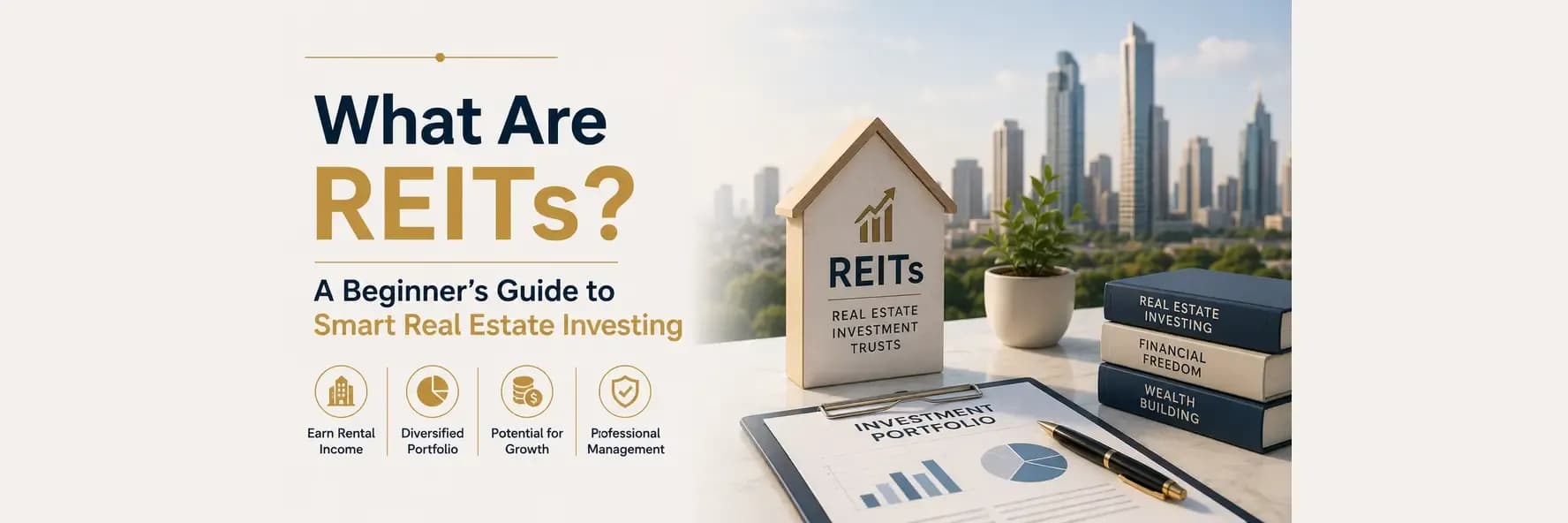
A Real Estate Investment Trust is a company or fund that owns, runs, or finances a portfolio of income-generating properties, residential blocks, office towers, retail units, and sometimes mortgages tied to real estate. You buy shares in the trust rather than a slice of any one building, and in exchange you get a cut of the rental income, paid out as dividends (AiGentsRealty; Emirates NBD).
What makes the structure interesting is that it borrows from two worlds people usually think don't mix: the steady income feel of owning property, and the liquidity of owning a stock. REITs trade on public exchanges. Buying or selling takes seconds during market hours. Compare that to the months it usually takes to close on an actual building, and the appeal starts to make sense (AiGentsRealty).
How REIT Investing Works in the UAE
Here, REIT investing runs through the Dubai Financial Market (DFM) and Nasdaq Dubai, both regulated exchanges where investors trade REIT units the same way they'd trade any listed stock. UAE-listed REITs must hand out at least 80% of annual net profit to unitholders. That single rule is really the whole engine behind why income investors pay attention to them (Propertyfinder; Emirates NBD).
And the market's grown fast. Dubai Residential REIT listed on the DFM in May 2025, carrying a gross asset value of AED 21.6 billion across more than 35,000 homes in 21 Dubai communities, backed by AED 56 billion in demand at IPO. That made it the GCC's largest pure-play residential leasing REIT out of the gate (Kayrouz & Associates; Gulf News). Its projected dividend yield at IPO landed around 7.7% to 7.9% for 2025 (Gulf News). Emirates REIT got there first, back in 2010, and remains one of the biggest Sharia-compliant REITs in the region by assets under management (Land Sterling).
REIT Benefits Worth Knowing
Strip away the jargon and the real REIT benefits come down to a handful of practical points, all measured against buying a physical property outright.
Entry cost, first. Direct ownership in Dubai often starts around AED 500,000. REIT investing can start at AED 500 to AED 10,000 through a brokerage account, depending on the platform (Orchid Homes; AiGentsRealty). That gap alone changes who gets to participate.
Liquidity is the other obvious one. Selling a physical property typically eats three to twelve months and costs 6% to 8% in fees. Selling REIT shares takes seconds during trading hours, at something closer to 0.5% to 1% in transaction costs (AiGentsRealty).
Diversification comes built in. One REIT share hands you exposure to an entire portfolio spread across locations, sometimes across property types too, instead of betting everything on a single unit in a single building (Driven Properties).
Someone else handles management. REITs are run by dedicated fund managers who deal with leasing, acquisitions, and upkeep, so there's no landlord role on your end (Driven Properties; Emirates NBD).
And there's a tax angle. Qualifying REITs in the UAE can benefit from corporate tax exemptions, and dividends generally aren't subject to withholding tax, nor is there personal income tax for most investors at the federal level (Propertyfinder).
REITs vs Direct Property Ownership: Key Differences
Neither route beats the other outright, they're just solving different problems. Direct ownership gives you full control of the asset, the option to leverage it through a mortgage, and potentially higher yields if you pick well, but it demands real capital and real involvement (AiGentsRealty).
There's also a Golden Visa wrinkle worth flagging if that's part of your thinking: buying shares in a REIT or listed property company doesn't count toward residency-by-investment programs. Only direct ownership hitting the AED 2 million threshold qualifies for the 10-year Golden Visa (GetStake).
So if the goal is a physical home, a family asset, or Golden Visa eligibility, direct ownership is the only door that opens. If the goal is real estate exposure with liquidity and a low entry point, REIT investing solves a genuinely different problem.
How to Start Investing in REITs
Wondering how to start investing in REITs in the UAE? It's less bureaucratic than it sounds.
- Get a National Investor Number (NIN) through the DFM or Abu Dhabi Securities Exchange. Around 15 minutes at a licensed brokerage, or directly through the exchange. You'll need your Emirates ID, passport copy, and proof of address (RiseExpo).
- Pick a broker. The big banks, Emirates NBD Securities, FAB Securities, and similar, offer stability but charge around 0.275% per trade with a minimum fee. Other platforms sometimes come in cheaper (RiseExpo).
- Look at what the REIT actually holds. Residential, commercial, mixed-use, check the portfolio, the dividend track record, and occupancy levels before putting any money down.
- Place the order through your broker's platform, DFM's iVestor app is one option, and track the position the way you would any listed stock (DFM).
One catch worth knowing: if you want access to both DFM and ADX-listed REITs, you'll need a separate NIN for each exchange (RiseExpo).
Real Estate Investing Tips for Beginners Choosing REITs
A handful of real estate investing tips specific to going the REIT route:
- Look past the headline yield. A projected dividend at IPO is a projection, not a promise. Check how consistently a REIT has actually paid out over time.
- Know what's inside the portfolio. Residential, commercial, and mixed-use assets each behave differently depending on the economic weather, so don't buy blind.
- Remember these are equities. Prices move with market sentiment, not just property fundamentals, so expect more day-to-day volatility than a physical property's slower-moving value.
- Spread it out. Holding shares across more than one REIT does more for your risk profile than parking everything in a single trust.
Risks to Understand Before You Invest
REIT investing isn't a free lunch, and it's worth being straight about that. Oversupply in certain residential or commercial segments can squeeze rents and occupancy, which flows straight into dividend payouts. Rising interest rates push up a REIT's borrowing costs, which can pressure distributions too. Regulatory or tax changes can shift the picture further, and if you're investing from outside the UAE, currency exposure is worth factoring in as well (Propertyfinder).
None of that makes REITs a bad idea. It just means they carry real investment risk like any other listed security, not the guaranteed-income story some marketing pages like to imply.
Getting Started
Whichever way these real estate investing tips point you, toward REIT investing, a direct purchase, or a bit of both, the underlying goal doesn't change: exposure to a market that's historically rewarded patient, well-researched money. REITs get you in the door with a lower bar and genuine liquidity. Direct ownership hands you control, leverage, and a path to residency benefits that REITs simply can't offer.
If direct property ownership is part of your plan, explore Purvanchal's current projects, or get in touch with our team for a straight conversation about what actually fits your goals and budget.
Also read: Rental Yields on Dubai Property 2026
Frequently Asked Questions
1. What is REITs in simple terms?
A REIT (Real Estate Investment Trust) is a company or fund that owns income-generating properties and pays most of the rental income out to shareholders as dividends. You buy shares in the trust rather than owning a specific property outright.
2. How to start investing in REITs in the UAE?
Open a National Investor Number (NIN) through the DFM or ADX, pick a licensed broker, look into the specific REIT's portfolio and payout history, then place your order through the broker's platform. The account setup itself usually takes about 15 minutes.
3. What are the main reit benefits over buying property directly?
Lower entry cost, faster liquidity, built-in diversification across multiple properties, and professional management running the day-to-day. REIT shares trade in seconds; a physical property sale takes months.
4. Does REIT investing qualify for a UAE Golden Visa?
No. Golden Visa eligibility through property requires direct ownership meeting the AED 2 million threshold. Buying shares in a REIT or listed property company doesn't count toward that.
5. Is REIT investing safer than buying physical property?
Not safer exactly, just differently risky. REIT prices move with broader market sentiment and react to interest rate shifts and occupancy changes, while direct property tends to hold its value more slowly but demands far more capital and hands-on involvement.