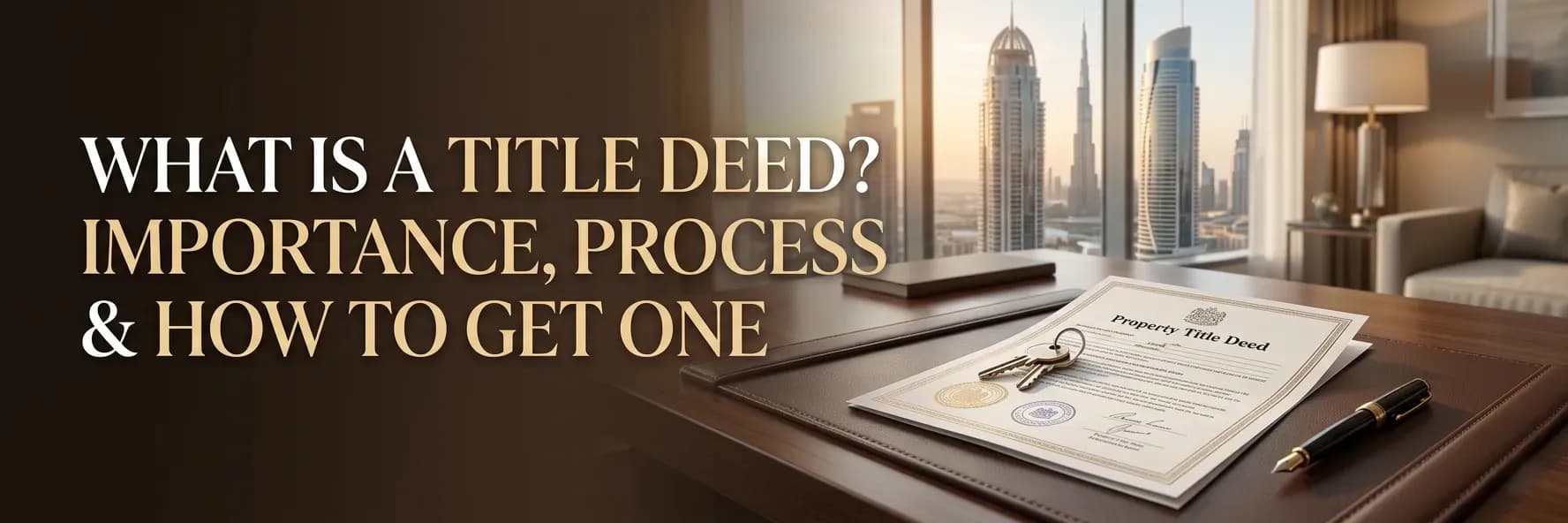
Title Deed Meaning: What Exactly Is It?
A title deed is a legal document that confirms ownership of a property. That is the short answer.
The longer answer: think of it as the property's ID card. It carries your name, the property's exact location, its size, its plot number, and any rights or restrictions tied to it. In Dubai, this document is issued by the Dubai Land Department (DLD), and locally it is also called Sanad in Arabic. Some people still refer to the older paper version as Mulkiya. Same idea, different name.
Without a registered title deed, you do not legally own the property — even if you have paid for it in full. Until your name appears in the DLD's Real Property Register, you are technically just a contractual buyer. The deed is what flips that switch.
Property Title Deed vs Sale Agreement: The Difference
A lot of first-time buyers mix these two up. They are not the same thing.
The Sale and Purchase Agreement (SPA) is the contract between buyer and seller. It says "I will buy this from you for X amount." It is enforceable, sure. But it does not transfer ownership.
A property title deed, on the other hand, is the actual proof that ownership has changed hands and been recorded with the government. The SPA is the promise. The title deed is the receipt.
Why a Title Deed Matters More Than Most Buyers Realise
People often see the title deed as a formality. It is anything but.
Here is what your title deed actually does for you in real life:
- Proves you legally own the property: Courts, banks, and government departments all recognise this document. Nothing else carries the same weight.
- Lets you sell, mortgage, or transfer the property: No deed, no transaction. Banks will not approve a mortgage without it. Buyers will not pay without seeing it.
- Protects you against fraud and ownership disputes: Property fraud does happen. A clean, verified title deed is your single best defence.
- Required for residency and Golden Visa applications: If your property purchase is part of a long-term visa plan, the deed is what authorities check first.
- Used in inheritance and gifting: Passing the property to family members? The transfer happens through the title deed, not your will alone.
So yes — when people say it is "just paperwork," they are wrong. It is the paperwork.
Title Deed Dubai: What Makes It Different?
Dubai's system is, frankly, one of the cleanest property registration systems in the world. That is not marketing fluff — it is built into how the DLD operates.
All title deeds in Dubai are governed by Law No. 7 of 2006, which lays out how property ownership is recorded and protected. Every registered property sits in the DLD's Real Property Register, which is now fully digitised. Many deeds are blockchain-verified, which makes tampering nearly impossible.
A few things you should know about a title deed Dubai:
- Most deeds today are digital: DLD emails them directly. Physical paper certificates are still issued on request, but digital is the norm.
- Foreigners can hold them: In designated freehold areas (Dubai Marina, Downtown, JVC, Al Furjan, and many others), non-UAE nationals can own property outright with a full freehold title deed.
- Different types exist: Freehold (full ownership), leasehold (long-term lease, usually 30–99 years), and usufruct (right to use without owning the land).
- Verification is instant: You can verify any title deed Dubai through the Dubai REST app — for free.
That last point is huge. Before paying any seller, anywhere in Dubai, run the deed through Dubai REST. If it does not check out, walk away.
What Information Does a Dubai Title Deed Contain?
Open up any standard DLD title deed and you will see fields like these:
- Owner's full name and identification details
- Property type (apartment, villa, plot, commercial)
- Plot number and community name
- Built-up area and net usable area
- Property location with map reference
- Issuance date
- Any registered mortgages, encumbrances, or restrictions
- Unique title deed number for verification
If anything on this list is missing, blurry, or feels off, do not sign anything. Get the deed verified through DLD first. Always.
How to Get Title Deed in Dubai: The Step-by-Step Process
Now to the part most readers actually came here for. You have decided to buy a property. How do you go from "interested" to "deed in your inbox"?
Here is the full process, broken down step by step. The whole thing usually takes 5 to 7 working days from transfer to deed issuance, sometimes faster.
Step 1: Sign the Sale and Purchase Agreement (SPA)
This is where the buyer and seller agree on price, payment terms, handover date, and anything else relevant to the deal. The SPA is signed by both parties — usually after the Memorandum of Understanding (MoU) is in place. If you are working with an agent, they will draft this. Read every line. Especially the payment schedule.
Step 2: Get a No Objection Certificate (NOC) from the developer
If the property is in a developer-managed community, you need a NOC from them confirming there are no outstanding service charges or other issues. The developer issues this directly. Costs typically range between AED 500 and AED 5,000, depending on the developer. It is valid for 14 to 30 days.
Step 3: Visit a Real Estate Trustee office
This is where the magic happens. Both buyer and seller (or their authorised representatives) attend a DLD-approved Trustee office. Bring your documents. Pay the fees. Sign the transfer.
Step 4: Pay the DLD transfer fee and admin charges
The standard DLD transfer fee is 4% of the property's sale value. On top of that, expect administrative fees of around AED 4,000 to AED 5,000, plus the Trustee office fee (usually AED 2,000 to AED 4,000 + VAT). Cheques must be exact. Wrong amounts get bounced back, which delays everything.
Step 5: Receive your electronic title deed
Once the transfer is processed, the new title deed is issued in the buyer's name and emailed directly. Most buyers get it within minutes of completing the transfer. You can also access it through the Dubai REST app immediately.
And that is genuinely it. Five steps. One government department. One deed in your name. The system has been refined to be this clean for a reason.
Documents You Need to Get Title Deed in Dubai
Show up to the Trustee office without these and you will be sent home. Save yourself the trip. Make sure you have:
- Original passport copies of buyer and seller
- Emirates ID (for residents)
- Original title deed from the seller (for resale properties)
- Signed Sale and Purchase Agreement (SPA)
- No Objection Certificate (NOC) from the developer
- Manager's cheques for DLD fees and seller payment
- Mortgage release letter (if the property had an existing loan)
- Power of Attorney (if a representative is acting on your behalf)
Companies buying property need additional paperwork — trade licence, shareholder certificate, and corporate authorisations. If that applies to you, give yourself an extra day or two to gather everything.
Off-Plan vs Ready Property: How Title Deeds Work Differently
This is where a lot of first-time buyers slip up. Off-plan and ready properties follow different paths to the title deed.
For ready properties, the process above applies directly. You buy, you transfer, you get the deed within a week. For off-plan units (where the project is still being built), the initial registration happens through the Oqood system. Oqood is essentially an interim ownership record. The actual title deed only gets issued once the project is completed and handed over. If you are exploring off-plan deals, our guide on off-plan properties in Dubai walks through this in more detail.
So when someone says "I bought an off-plan apartment in Dubai," they have an Oqood. Not a title deed. Not yet.
Common Mistakes Buyers Make Around Title Deeds
After years of watching buyers go through this, certain mistakes show up over and over:
- Skipping deed verification: Always verify the seller's deed through Dubai REST before paying anything. Even if it is a friend selling. Trust, but verify.
- Ignoring encumbrances: If the deed shows a mortgage, lien, or court restriction, that has to be cleared before transfer. Some buyers find out too late.
- Mismatched names: If the seller's passport name does not exactly match the deed (common after marriage or passport renewal), the transfer gets blocked. Fix this early.
- Wrong cheque amounts: Manager's cheques have to be exact. Even AED 1 off and the transfer halts.
- Missing the developer NOC: This expires fast. Time the rest of your process around it, not the other way around.
None of these are technically complicated. They just need attention. The process is forgiving once you know what to expect — but unforgiving when you do not.
Why the Title Deed Is So Important for Investors
If you are buying purely as an investment, the title deed is your safety net. It establishes your legal claim, lets you rent out the property without dispute, supports mortgage refinancing, and can even back a Golden Visa application. Speaking of which — if that is part of your plan, our breakdown of the Golden Visa through property investment walks through exactly how the deed plays into that process.
Investors also use the title deed for tax planning — though Dubai's structure is unusually friendly here. Our piece on Dubai's tax-free advantage explains why this matters in real terms.
The deed is what turns the investment from "on paper" into "on the books." Without it, you have a contract. With it, you have an asset.
Buying Property in Dubai? Start with a Developer You Can Trust
A clean title deed starts with a clean transaction. And a clean transaction starts with the right developer.
At Purvanchal Real Estate, we have spent over 30 years building homes for people who care about doing things properly. Every project we deliver in Dubai is RERA-registered, fully documented, and handed over with the title deed process taken care of from start to finish. No grey areas. No surprises. Just homes you can actually call your own.
Have a look at our ongoing projects, or read more about real estate investment in Dubai before you take the next step. When you are ready, get in touch — our team will walk you through it, deed and all.
FAQs: Title Deed in Dubai
1. What is the title deed meaning in simple terms?
The title deed meaning is straightforward — it is the official government document that proves you legally own a property. In Dubai, it is issued by the Dubai Land Department and contains your name, the property's details, and any rights or restrictions tied to it. Without it, you cannot sell, mortgage, or transfer the property in the eyes of the law.
2. How long does it take to get a title deed in Dubai?
For ready properties, the title deed is usually issued within minutes of the transfer being completed at a Trustee office, and the whole transaction typically wraps up in 5 to 7 working days. For off-plan properties, you receive an Oqood at booking and the actual title deed only gets issued once the project is handed over, which depends on construction timelines.
3. How much does it cost to register a property title deed in Dubai?
The DLD transfer fee is 4% of the property's sale value, paid by the buyer. On top of that, expect around AED 4,000 to AED 5,000 in administrative fees and AED 2,000 to AED 4,000 plus VAT for the Real Estate Trustee office. Title deed amendment fees, if needed later, are around AED 270 in total.
4. Can foreigners get a title deed in Dubai?
Yes, absolutely. Foreign nationals can hold full freehold title deeds in Dubai's designated freehold areas — including Downtown Dubai, Dubai Marina, JVC, Al Furjan, and many others. There are no nationality-based restrictions in these zones, and the deed is identical in legal status to one held by a UAE national.
5. How do I verify a title deed Dubai?
The fastest way is through the Dubai REST app, which lets you instantly check whether a deed is genuine and matches DLD records. You can also verify it through the DLD's website or in person at any DLD office. Always do this before paying any seller, regardless of how trustworthy they seem.
6. What happens if I lose my property title deed?
Do not panic — most title deeds today are digital, so a lost paper copy is rarely a real problem. You can re-download the digital deed through the Dubai REST app or request a duplicate from DLD. Lost paper certificates can be replaced for a small fee after submitting an affidavit at a DLD office.
Popular Searches:
Triana Residence | Sunbliss Residences Al Furjan | Purvanchal Villa | Purvanchal Townhouse | 1 BHK Apartment for Sale in Dubai | 2 BHK Apartment for Sale in Dubai